The August 2008 Murder of Olympic Volleyball Head Coach Father-in-Law
Todd Bachman Triggered by Coalition Agenda & President
Bush’s Irresponsible Coercive Diplomacy
© 2011 Brad Kempo B.A. LL.B.
Barrister & Solicitor
In the coalition’s non-transparent diplomatic environment everything that sought to protect the peace, security and prosperity of the 21st century’s globalizing world was tried short of military action, rendition, selective assassination, economic sanctions and international asset seizure. Because it was a non-public arena Beijing’s leaders and their Canadian partners believed they could get away not only keeping Canada a totalitarian state and a base of operations and piggy bank for China’s global aspiration; and for enslaving, experimenting upon and torturing a lawyer for twenty years. They never put their mind to the likely eventuality the entire planet would know about and demonize them for what they are and did to protect their domestic hegemony north of the 49th Parallel and the worldwide proliferation of anti-democratic political and corporate cultures.
In retrospect it’s fair to argue it was reasonable to expect casualties in the secret war that President Bush declared on May 5, 2006 and which Congress ratified against China and Canada. Like the Soviet conflict many perished in that shadowy world of spy v. spy; and some innocents got caught in the crossfire between the expansionistic ideologies of communism and democracy. The major difference, however, was the methodologies of dominos-style advancement and defense were military in nature. Today it’s mostly about using capitalism in its various forms to gain strategic advantages. The only militaristic component in the early 21st century is the twenty year Article 7 violating program that produced stealth cognition technologies and the Pentagon employing technical capabilities and personnel to engage in surveillance and intel collection devices to discover how it operates so as to neutralize its effects and prepare the prosecution’s evidence record. Nobody, especially outside the conflict, was supposed to die.*
* In Canada the Custodian Chief was the victim of two attempts by the Chinada High Command: one in October 2004 and the second in February 2010, both documented in How the Chinada High Command Reacted to Condemnation for Turning the 2010 Winter Games into the Evil-ympics: An Assassination Attempt; and in May 2009 hypno-assassination (1, 2)
Well, someone did; in fact almost two. The targets and one victim were American who happened to be in the wrong place at the wrong time and caught in that proverbial crossfire. The place: Beijing, China. The date: August 9th - day one of the 2008 Summer Olympics. Unannounced to them and the world the battle literally between good and evil – the forces of democracy, rule of law, human rights and moral decency amassed against enthusiastic evil – took center stage the morning after the athletes had paraded into the arena of friendly competition. Hiding in those shadowy crevices the Chinese secret police and military waited for a visiting American family to walk into an ancient temple that had massive historic meaning and which was showcased the night before in front of the whole world.
American killed at Games was coach's father-in-law
CNN.com
August 8, 2008
BEIJING, China -- A Chinese man wielding a knife stabbed an American couple in central Beijing on Saturday, killing the man and seriously wounding the woman before jumping to his death from an ancient tower, said U.S. Olympic officials and state-run media. […] The U.S. Olympic Committee identified the dead man as Todd Bachman, the father-in-law of Olympic Men's Indoor Volleyball Head Coach Hugh McCutcheon. Bachman's wife, Barbara, suffered "serious and life-threatening" injuries, the committee said.
The Fiefdom treatise analysis was accepted as compelling, proving this wasn’t a random act of a crazy man, but rather a premeditated murder to strike terror in the coalition’s collective mind. Immediately partners embraced the findings and fired salvo after salvo of condemnation at the Chinese responsible for this abominable act (1, 2).
Here’s an excerpt:
What begins the evidentiary analysis is what else went on during the day of the murder that intended disrespect towards the United States. Hours before the murder and attempted murder American Michael Phelps won the 400-meter medley. As the American National Anthem was coming to its crescendo – at “O’er the land of the free“ – the audio abruptly ended. The television audience saw the American winner smile; the director immediately cut to President Bush – in the company of his father and Secretaries of State Condoleezza Rice and Henry Kissinger – grimacing; and the East-West Corridor proprietor instantly surmised he’d just witnessed the Chinese secret police blatantly insult the American leadership – politicizing the Olympics to antagonize the entire coalition. This was nothing short of an infantile, confrontational display of diplomatic provocation.
US Anthem Cut Short at Water Cube
CNN/Sports Illustrated
August 10, 2008
BEIJING (AP) - Michael Phelps had his right hand on his heart, an Olympic gold medal around his neck and was listening to the closing notes of "The Star-Spangled Banner'' when the music went dead Sunday.
What is contained in news reports adds to the argument the murder sought to enrage coalition members and assert some kind of perverse superiority. One western publication offers a version of the events that strengthens the argument this was an assassination:
Reports on U.S. Tourist’s Murder False, Claims Source
by Fang Xiao
Epoch Times
August 12, 2008
A source in Beijing says that the murder in Beijing of American Todd Bachman and the wounding of his wife Barbara and their Chinese tour guide were committed by someone other than the individual identified in China’s state-run press.
The three were attacked on August 9 while visiting the Drum Tower, a popular Beijing tourist site. The next day, Xinhua reported that they had been murdered by a 47-year-old factory worker named Tang Yongming who had recently been thrown out of work. Tang was said to have committed the murder out of hopelessness and rage at society, and then to have committed suicide by jumping 150 feet to the concrete below.
According to the Epoch Times’ source, however, a local store clerk saw something different. Immediately after the murder a witness came out of one of the stores nearby where she works, shaken at what she had seen. According to this store clerk, the murderer was a very tall Chinese man between 30 and 40 years old in a business suit. The killer was said to be very agile and quick and used a double-bladed military knife to commit the murder.
The clerk says that there were security guards within 20 feet of the murder who did nothing to stop or apprehend the killer. While she and other witnesses were too shocked to react, the killer quickly ran away. The source pointed out “There was a tight security check there with many public security officers. No one could pass the security check with a weapon.”
[…]
A German report adds the following:
Beijing Murder Holds Important Clues for 2010
Openpr.com (Germany)
August 22, 2008
[T]the official version … made its way into the major media in the US and Europe, such as the New York Times. However, some China experts are cautioning that, while Tang's attack may have been triggered by mental illness, killing a foreigner at the Drum Tower may not be quite as random as Chinese authorities are portraying it. “Drum Tower, suicide, knife, foreigners,” says Susan Brownell, a Fulbright senior researcher in Beijing who wrote a book about the meaning of the Olympics to China. “There's definitely some symbolism there.
What is that “symbolism” operating here? The Drum Tower was built in 1380, the 13th year of the reign of Emperor Hongwu of the Ming Dynasty.
Hongwu realized that the Mongols still posed a real threat to China. He decided that the orthodox Confucian view of the military as an inferior class to the scholar bureaucracy should be reassessed, as maintaining a strong military was essential. Hongwu kept a powerful army organized on the military system known as Wei-so. Hongwu attempted to, and largely succeeded in, consolidating control over all aspects of government, so that no other group could gain enough power to overthrow him.
Source: wikipedia.com
The significance of drums is traced back to ancient battlefield culture:
Drums were both to raise own morale and to intimidate the enemy. The drums are beaten to give the order to attack.
Source: chinahistoryforum.com
Drums played a very high profile role in both the Olympics opening and closing ceremonies – a signal to Chinese agents around the world the attack [against the modern world] is on. 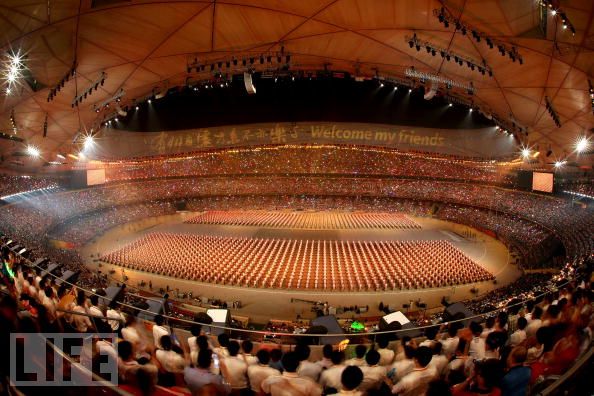
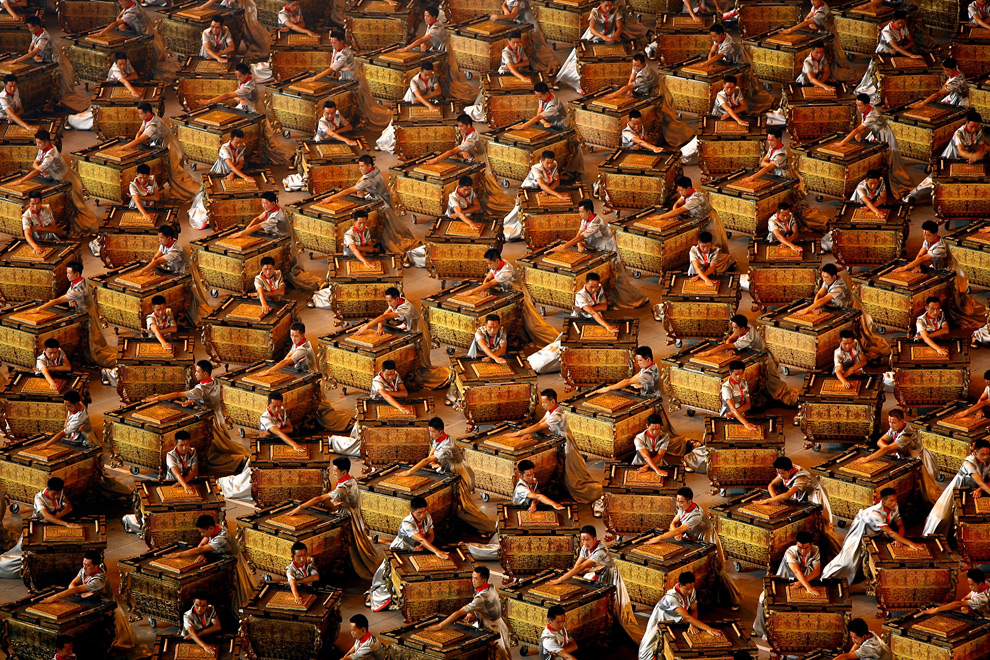
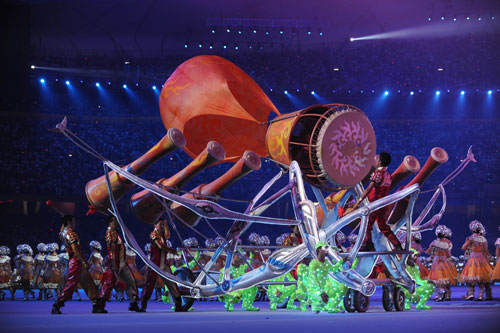
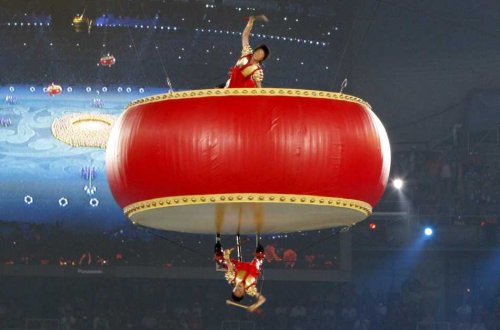
The number ‘47’ -- the age of the so-called attacker -- entered the lexicon on the one-month anniversary of the murder. President Bush took the initiative and added it to the coalition’s confidential language: The Number '47' Enters the Coalition Lexicon as the Assassination Reminder*.
* Assassination reminders in 2009: 1, 2, 3, 4, 5, 6, 7, 8, 9, 10, 11, 12, 13, 14, 15, 16, 17, 18, 19, 20, 21, 22, 23, 24, 25, 26, 27, 28, 29; in 2010: 30, 31, 32, 33, 34, 35, 36, 37, 38, 39
What triggered this cold blooded murder had less to do with non-stop coercive diplomacy since the spring of 2006 and everything to do with President Bush threatening principals and major operatives of the Chinada High Command with assassination at a G8 Summit they attended in Japan exactly one month to the day before the killing. Their public appearance, timed by the White House to commence at exactly 3:33 p.m. (lexiconically a coalition identifying coalition identifier), began with the U.S. leader employing the ‘gun to the temple’ Richie-Santelli Maneuver* as he's articulating how the discussions between them are "candid".
President Bush Meets with President Hu Jintao of the People's Republic of China
Windsor Hotel Toya Resort and Spa
Toyako, Japan
3:33 P.M.
Pres Bush: [R-S M.] Mr. President, thank you very much for your time. We -- you and I have had a lot of meetings together, and I always appreciate the candid discussions on a variety of issues.

* A Retrospective on Coercive Diplomacy Employing Powell, Richie-Santelli and Execution Maneuvers; then R-S M.s in 1, 2, 3, 4, 5, 6, 7, 8, 9, 10(1), 11, 12(2), 13, 14(3), 15, 16(4), 17, 18, 19, 20(5)
(1) U.S. Vice-President Biden; (2) Dalai Lama; (3) French President Sarkozy; (4) British Prime Minister Cameron; (5) President Obama’s daughter
Timeline recap:
July 9th: President Bush threatens President Hu Jintao
August 9th: Murder of Todd Bachman
September 9th: ‘47’ officially added to the diplomatic lexicon by President Bush
War is as ugly as it gets and wrought with perils and risks. Unfortunately, some innocents lose their lives.
Was it reckless of the President to threaten the Chinese Communist Party’s representative in a geo-politically observed way and in such an aggressive manner? In retrospect it can be argued it was.
Was Mr. Bachman’s death in vain? From one perspective it proved just how serious the Chinada threat had become, paralleling the same kind of barbarity observed in the terrorism theatre of war. And for that it had historic benefit. This shocking loss galvanized the coalition’s membership, especially in the United States, making each partner evermore fully appreciative they’re dealing with a profoundly grave matter. Paradigmatic of this sentiment is this Geo Award winning Photographic Diplomacy by tennis pro Andy Roddick at the U.S. Open three weeks after the crime:
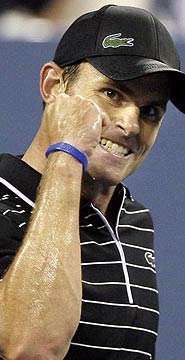
[and prison certainty]
* Read his geo-politicized interview in the Fiefdom supplemental
But the question has to be asked now that some 2½ years have elapsed since whether his publicly unknown sacrifice had value. With diplomacy having failed to produce any results beyond emboldening the Chinada High Command; with other methodologies of engagement not even tried to trigger capitulation the case can be made it, sadly, was. The coalition leadership has the means to put down this threat to our way of life as easily as euthanizing a rabid dog. Consequently, irreversible shame goes to all those who had the ability to address this painful chapter in the coalition’s history and didn’t.
What is also unsettlingly problematic is nothing being done prevents the Bachman family from exacting justice against responsible parties not residing in China – like those in Canada who while not wielding the knife were just as responsible.
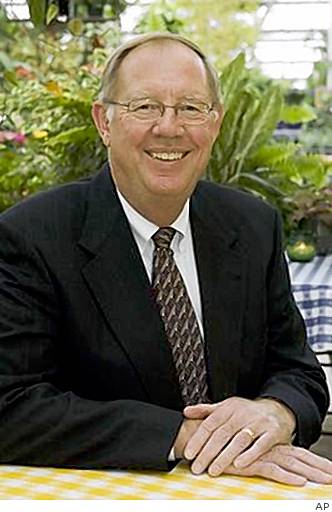
Bachman's mourns a beloved CEO
Across the U.S., colleagues remembered a boss who always pitched in.
by Josephine Marcotty
Star Tribune
August 11, 2008
At Bachman's flagship store on Lyndale Avenue in Minneapolis Sunday, a giant array of flowers and a poster commemorating the life of Todd Bachman stopped customers as they walked in. Behind the memorial, the wall was lined with historic photos of the four generations of Bachmans that built their iconic Minnesota company.
[…]
Todd Bachman was a great grandson of the immigrant German who in the late 1800s bought 4 acres in what is now south Minneapolis and started selling vegetables.
According to employees working Sunday, he was one of the most beloved of a long line of Bachmans who have continued to run the floral and garden centers. "I don't think that in 20 years I ever saw him mad," said Pfarr. "You could always go to him with anything, and he would always listen."
He was named CEO in 1994 but shared control with his cousins, overseeing 1,300 employees at 29 locations.
Rick Mierva, who has worked at Bachman's for 31 years, said his phone started ringing early Saturday. Employees and people in the nursery business all over the country called to find out if the news was true. Employees said Todd Bachman had a gift for making them feel they were part of the Bachman family.
"He's been to Florida with us on buying trips," said Mierva, in charge of buying the company's annuals. "He's been with us traipsing through those broken-down greenhouses in the heat. He never played executive. He enjoyed it."
Jon Logue met Bachman while working at Department 56, a giftware company Bachman's started.
"He was always very interested in what you were doing," he said. "He was the first person to give you encouragement."
He always pitched in as needed, Logue said. While setting up the post-Christmas sale this year, Logue and Bachman kidded each other about how they still hadn't mastered the skill of packing complicated Department 56 product boxes.
[...]
"It's a tragedy for the business and the family," she said. "The people in Minnesota feel like this is a family member that this happened to."
--------------------------------------------
Bachman’s Inc.
The business was founded by German immigrant Henry Bachman Sr. in 1885 and is now led by 4th and 5th generation family members. The company operates 29 retail stores and employs 1,600 people during peak season. [more below]
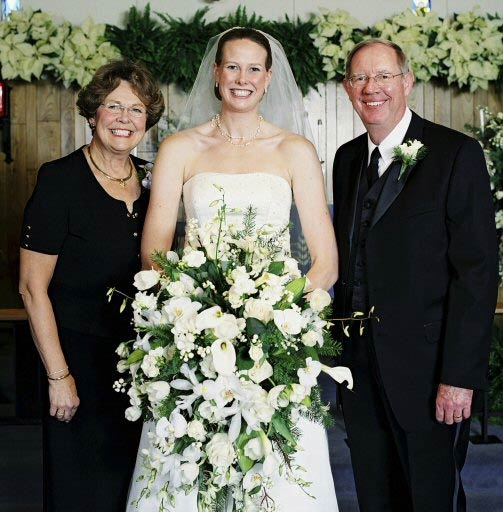

Bachman's Inc., family owned and operated for over a century, provides homes and businesses with a variety of horticultural-related products and services. The company's distinctive purple delivery trucks are a fixture of the Twin Cities floral market. In addition to marketing flowers and plants, Bachman's operates nursery and landscaping services and floral, gift, and garden centers.
Henry Frederick William Bachman moved to the Minneapolis area in 1882, at the height of German immigration to Minnesota. Bachman worked in his uncle's vegetable and garden business and at a large fruit and produce company before striking out on his own. With his wife, Hattie, Bachman established a vegetable farm in 1885 on four acres of land. Their first harvest included potatoes, lettuce, onions, and squash.
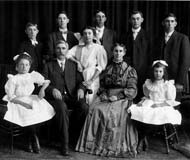
Henry Sr. and wife Hattie with their children,1908
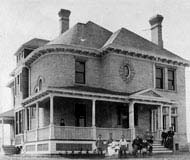
The Bachman family home, built 1890s
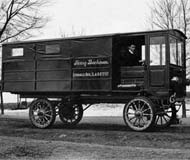
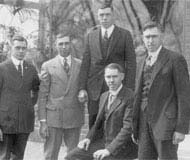
Fred Bachman delivering produce in a chain-driven Wilcox, 1910; and
five Bachman sons pose in front of their newly constructed
Lyndale retail store, 1927
Over the next decade the couple's family and holdings grew. By 1895, Bachman had 150 hotbeds and 11 greenhouses on his 44 acres of land. The Bachman children helped sustain the growing business. The boys worked in the fields and the greenhouses, while the girls helped their mother with meals for the hired hands.
In 1911, Bachman convinced a railroad company to build a spur line to his property, and he began transporting his produce to New York and Boston. In the winter months he manned the coal stove in the boxcars to keep the squash and potatoes from freezing during the long haul. He returned with a load of Eastern coal to heat the greenhouses. But in the 1920s, capitalizing on improvements in transportation, Southern farmers began pricing Northern greenhouse growers out of the market. Bachman's began shifting the balance of production from vegetables to flowers.
Floral production began with Albert Bachman, who had inherited his mother's passion for flowers. Despite teasing from his brothers, he began raising carnations on his greenhouse bench--each of the brothers had an allotment of space. "Before long he was tying bunches of carnations together and selling them outside the gates of Oak Hill Cemetery. His modest income did not challenge his brothers' belief that there was anything but folly in the growing of flowers," according to Purple Packages: Bachman's 100 Years.
Two years later, in 1916, Henry, seeking relief from his asthma symptoms, moved to California with Hattie and their three daughters. The homestead was divided among their sons. Albert and his wife, Olga, expanded the flower production. "By the end of the 1920s an armful of carnations was earning more than a truckload of Minnesota-grown vegetables and everybody had stopped laughing at Albert," wrote Dick Youngblood. On April 9, 1929, the family business was incorporated as Henry Bachman's Sons.
In the early 1930s Albert established a nursery and landscape division which was operated by his son Larry. As their parents before them, the third generation of Bachmans had begun working in the family business at an early age. The boys worked in the fields and made deliveries. The girls helped with meals and laundry for the hired hands and worked in the retail store, which had been established in the mid-1920s.
Situated between a greenhouse and a tropical conservatory, the retail store offered flowers for 35 to 50 cents a bunch during the Depression years. Bachman's also filled floral arrangement orders, such as funeral wreaths, and began carrying some gift items.
World War II intervened in the lives of every American including the Bachmans. With the young men in military service, the women moved into accounting and production areas. Additional employees joined the ranks of the family business--some of whom later became family members as well. Albert and Olga lost a son to the war.
Bachman's began expanding in the postwar days. The Edina retail outlet, which had opened in 1941, was replaced by a larger store in 1947. The next year, the company established a vehicle service operation and purchased additional land and greenhouses next to Lake Minnetonka. The company also began to establish a reputation as an industry innovator by marketing techniques such as displaying premade floral arrangements in large coolers in the retail stores.
In 1949, seven cousins formed the new leadership of the company, renamed Bachman's Inc. The business structure was formalized with Ralph Bachman heading the company as president. The goal of the third generation, according to the Bachman's company history, was "to sell more flowers to more people more often."
A flower shop opened in Dayton's downtown Minneapolis store early in the 1950s and in Southdale mall, also owned by Dayton's, in 1957. The Lyndale Avenue store--part of the original Bachman family homestead--was converted to a "supermarket" operation in 1958. Cart-pushing customers picked up plants from display tables and paid for their purchases at checkout counters. Sales skyrocketed.
With 1959 sales of $2.2 million, Bachman's ranked among the top five retail florists in the United States. Retail florist business accounted for 78 percent of sales, and the garden store and nursery operations brought in the remaining 22 percent. Sales had more than tripled in the decade since the passing of the torch to the third generation of Bachmans, who held all the company stock.
"More than two-thirds of Bachman's products are homegrown, progressing from seed to sale in its 34 greenhouses and three growing areas," wrote Bob Ylvisaker. But with expansion of air transportation during the 1950s Bachman's, like others in the florist industry, began bringing in more flowers from around the U.S. and the world. Some plants were more economical to purchase than produce. Bachman's reached out to the world in another aspect of its business as well, by telegraphing flowers internationally.
Bachman's moved into the mass marketing of flowers in the late 1960s. The first European Flower Market opened at Byerly's Foods in 1968. The small kiosks carried cut flowers and plants priced below regular florist shops. Ralph Bachman, then president, extended the concept to other supermarkets, as well as airports and department and discount stores. By 1970, the company operated 22 European Flower Markets in Minnesota. An additional 35 were operated by local florists in 15 states, Canada, and Norway.
The Pillsbury Company purchased the division in 1971, and Ralph Bachman ran the operation for the Minneapolis food giant. Stanley Bachman succeeded his brother as president of Bachman's. When expansion plans failed to meet expectations, Pillsbury sold the Minnesota segment of the operation back to Bachman's in 1976.
Bachman's upgraded its production facilities early in the 1970s. A $1 million greenhouse complex was added at Lakeville, Minnesota--a 438-acre site purchased in the mid-1960s for nursery production. The modern facility was equipped with artificial lighting and an automated watering system.
Although marked economic inflation during the 1970s hit the florist industry, causing fertilizer, transportation, and energy prices to escalate, Bachman innovation and persistence continued to drive the company forward. In the late 1970s, Bachman's spent over $2 million to transform its Lyndale Avenue store into a shopping center-greenhouse offering customers a broad range of products and services.
According to a February 1980 Corporate Report Minnesota article, average annual sales for retail florists--typically family-owned businesses--were about $100,000. Bachman's ended the 1970s with sales of $25 million. And after-tax profits had been averaging two to three percent of sales from 1975 to 1980. According to John Lundquist, the company invested about a half million a year on advertising.
In an effort to keep the company vital, Bachman's shifted from a general manager to executive committee system in 1979. Merchandising Vice-President Ed Bazinet was one of the non-family members moved into a leadership role. Three years earlier, Bazinet had convinced the Bachman family to invest $50,000 in a gift wholesale division, eventually called Department 56. "Department 56's gift lines--virtually all developed by Bazinet--include ceramics, porcelain, bone china, toys, brass, ornaments, and music boxes. The most popular line is Snow Village, a collection of picturesque miniature buildings," reported Corporate Report Minnesota in December 1983.
Southeast Asian and European companies manufactured the giftware, and Bloomingdale's, Macy's, Neiman-Marcus, and Dayton's, were among the department stores carrying Department 56 items. The operation, which became known by its original accounting number, also sold to thousands of gift shops and national catalog companies. In 1984, the $15 million department was spun off as a subsidiary, and Ed Bazinet was appointed president. By then less than 10 percent of Department 56's products were sold by Bachman's retail stores.
The European Flower Market outlets, which had produced sales of $7.5 million in 1984, were eliminated in October 1989. The majority of the kiosks were closed and the names of the remaining outlets were changed to Bachman's. The company had shifted its retail focus to the other end of the spectrum.
"Bachman's opened a new store this month, but it isn't another of the firm's small gift shops that sell flowers in the company's signature purple wrap," wrote Barbara Pokela in a November 1989 Star Tribune article. The floral and garden center, their third store in the 75,000-square-foot range, carried everything from gardening supplies and gifts to patio furniture. Pokela reported the company wanted to alter the perception that Bachman's was only a flower and plant retailer, while remaining committed to its 30 smaller shops.
According to Bachman's company history, the company was an early promoter of foliage plants for home and business and began leasing plants in the 1960s. The interior landscaping division had sales of $3 million in the early 1980s. A decade later the Twin Cities plant leasing market, estimated to be about $10 million, began leveling off. Bachman's held about 1,000 accounts--ranging from $50 to several thousand dollars a month--in the increasingly competitive field.
Fourth generation family member Dale Bachman was named president early in 1992; his cousin Todd Bachman, who had headed the company since 1986, became CEO of Department 56. Forstmann Little & Co., a New York investment firm, purchased the Bachman's wholesale gift subsidiary late in 1992 for $284 million in stock and subordinated debt. Department 56, which had been growing by nearly 20 percent a year, had sales of $122 million in 1991.
The Twin Cities lawn and garden market, in spite of a series of setbacks in the late 1980s and early 1990s--drought, economic recession, and flooding--was expanding. In addition to the local garden store chains, Bachman's competed with discounters, home warehouse stores, and the Mall of America for the garden-related merchandise dollar. Bachman's closed three of its smaller stores and opened a fourth "superstore" in the Twin Cities in 1993.
Todd Bachman departed Department 56 and succeeded Stanley Bachman as chairman in 1994: the tradition of family leadership endured. Other traditions went forth as well. The annual Dayton's-Bachman's Flower show, held for over 30 years, continued to draw large numbers of Minnesotans eager for a taste of spring. And Bachman's persisted in its effort to creatively serve a changing marketplace.
The Corporate Report Fact Book 1997 estimated Bachman's sales to be $65 million. At year-end the company operated 21 retail floral stores, six of them the large floral and garden centers; the indoor and outdoor landscaping divisions; and the wholesale nursery division. Bachman's continued to grow many of its products in its seven acres of greenhouses and on its 513-acre growing range. A seventh floral and garden center opening was planned for 1998.
Source: http://www.answers.com/topic/bachman-s-inc
